

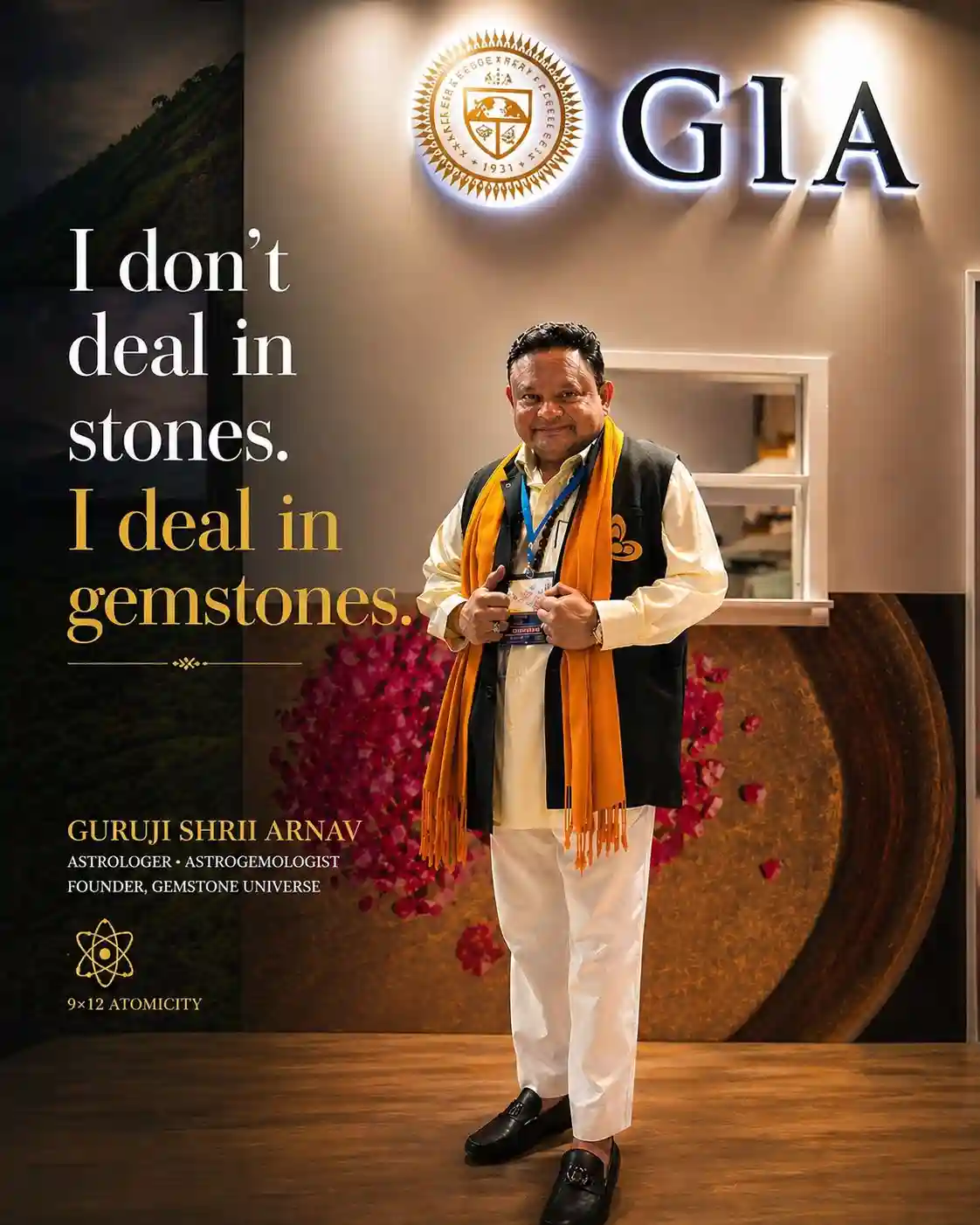
Revered Param Ajhan Guruji Shrii Arnav at the 73rd International Bangkok Gem and Jewellery Show.
Guruji Shrii Arnav: The Mentor of Mentors
In a world of fleeting trends and superficial metrics, Guruji Shrii Arnav stands as a singular force of clarity. Known globally as the “Mentor of Mentors,” he is a top 1% meta-cognitive reasoning expert and financial strategist who has spent decades bridging the gap between ancient Vedic wisdom and modern performance. As the founder of Gemstoneuniverse, he has pioneered the “Digital Legacy” project, transforming complex planetary energetics into actionable success for the world’s elite. To engage with his work is to step onto a 3,000-year trust route, where high-level strategy meets the spiritual precision of a contemporary Leonardo da Vinci.
An Indian Wedding Is Not Just a Celebration—It Is a Sacred Contract
In the Indian consciousness, a marriage is never merely a casual union or a social contract of convenience. It is the alignment of two families, two destinies, and two distinct karmic journeys. It is a “Sacred Contract” written in the language of the soul. When the vows are taken around the sacred fire (Agni), the couple invokes a divine witness to a transition that is as spiritual as it is legal.
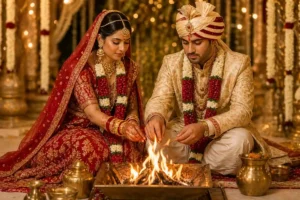
Sacred Beginnings — The Indian wedding fire (Agni) symbolizes divine witness and eternal vows.
In this high-stakes environment, jewellery has never served a purely decorative purpose. In the Vedic tradition, what we wear on our skin is an extension of our energetic field. Jewellery has always been symbolic, energetic, and—above all—intentional. As we move into a new era of bridal aesthetics, we are seeing a return to this intentionality, moving away from the “one-size-fits-all” diamond narrative toward the profound language of coloured gemstones.
Gold First, Always: The Foundation of Prosperity
Historically, the anchor of the Indian wedding has been gold. Long before the marketing of precious stones took hold, gold represented the four pillars of a successful union: purity, stability, prosperity, and continuity. It was the “safe haven” for both emotion and wealth.
Interestingly, diamonds were never central to this sacred exchange. While gold was the soul of the bridal trousseau, diamonds were often viewed as secondary or reserved for specific aesthetic embellishments rather than the core ritualistic value. The shift toward diamonds as a primary wedding stone is a relatively recent phenomenon in the context of India’s 3,000-year history of ornamentation.
The South Indian Insight: More Than Just “Red”
To understand why coloured gemstones are surging in popularity, we must look at the wisdom of South India. Here, the tradition of gifting organic red coral along with gold has remained unbroken for centuries.
This isn’t merely a fashion choice. Red coral signifies Mangalya Balam—the strength of the marital bond and a heavenly union that is sacred. It is a gemstone of vitality, gifted to ensure fertility, protection, and the blessing of Sumangali—a woman who remains married to a virtuous husband throughout her life.
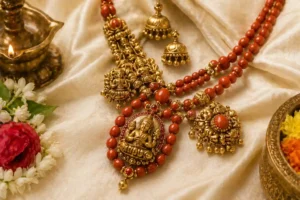
Tradition & Power — Gold and red coral representing Mangalya Balam and Sumangali blessings.
Today, many traditional Indian families consult an expert astrologer and Astro Gemmologists of Great Experience to select specific-coloured gemstones to be exchanged during the wedding vows, as these are considered highly auspicious, lucky, and essential for bringing long-term stability to the couple.
India: The Birthplace of Legendary Diamonds
It is a paradox that while diamonds were not central to wedding rituals, India was the original home of the world’s most magnificent diamonds. The legendary Golconda diamonds, including the world-famous Kohinoor, defined global standards for centuries. These stones were prized for their “pani”—an internal, watery brilliance that seemed to glow from within.
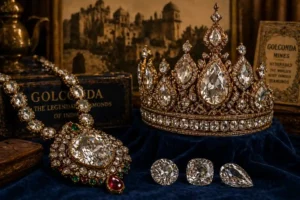
Heritage & Legacy — The legendary Golconda diamonds that once adorned royalty.
However, these were the stones of royalty and conquest, not the common marriage altar. They were symbols of power and sovereign status. The democratization of the diamond into the “wedding essential” we see today only began in earnest quite recently.
The Turning Point: 1991 and the Rise of Scale
The year 1991 marked a tectonic shift in the Indian economy. Economic liberalization opened the doors to global retail, aggressive advertising, and Western narratives. Love, commitment, and “forever” were suddenly packaged in the form of a diamond.
The industry quickly built scale. Today, the round brilliant cut dominates over 90% of the market. This dominance isn’t necessarily about beauty; it’s about standardization and scalability.
By making diamonds uniform, they became a commodity that could be traded and certified easily. Systems like the GIA brought much-needed trust to the market, but they also inadvertently shifted the buying process toward paperwork over experience. The modern bride often spends more time looking at a certificate than feeling the energy of the stone.
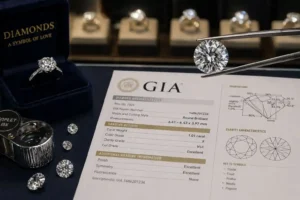
Modern Diamond System — Certification, standardization, and the rise of the round brilliant cut.
What the System Misses: The Experiential Impact
In the rush to standardize, something vital was lost. Current scientific evaluations focus on inclusions and “flaws,” but they rarely discuss the experiential impact of a stone. Traditional Indian systems looked deeper. They understood that a gemstone is a living node of energy that must align with the wearer.
In many Indian families, there was a tradition of testing diamonds. A stone would be kept under a pillow or tied to the arm for several days or weeks before it was accepted into the family.
Jewellery was validated through lived experience, not just a laboratory report. If the period of testing brought peace and progress, the stone was a keeper.
If it brought unrest, it was rejected, regardless of its “D-Flawless” status on paper.
Diamonds and Shukra: The Energy of Venus
From a Vedic perspective, diamonds are linked to Shukra (Venus). This planet governs beauty, luxury, and sensual pleasures. While these are desirable traits for a wedding, these energies require careful balance and are not universally suitable for every individual. For many, a diamond might be too “sharp” or “cold”. This realization is fuelling the current trend toward emeralds, sapphires, and mixed gemstone jewellery. Modern couples are realizing that their “happily ever after” might require the calming influence of a Blue Sapphire or the heart-opening growth of a Zambian Emerald rather than the sheer fire of a diamond.
The New Trend: From Uniformity to Individuality
We are currently witnessing a “Coloured Revolution” in Indian weddings. The shift is moving away from the uniformity of the mass-market diamond toward the individuality of the gemstone. +1
- Emeralds: Now a staple in high-end bridal sets, representing growth and rebirth.
- Rubies: Returning to their rightful place as stones of passion and authority.
- Multi-gemstone layouts: Reflecting the diverse, multifaceted nature of modern Indian life.
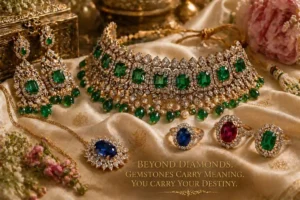
The Future — Coloured gemstones redefining individuality in Indian weddings.
Today’s bride wants a story that is uniquely hers. She is looking for stones that speak to her personality, her heritage, and her future.
Closing Thought
As we redefine the Indian wedding story, we return to an ancient truth. A diamond shines, capturing the eye with its external fire. But a gemstone speaks. It carries a frequency, a history, and a blessing.
In the journey of marriage, you don’t just need something that looks good under the spotlights of the mandap. You need something that resonates with your soul.
Gemstone Universe — Where the best version of your future meets you today.